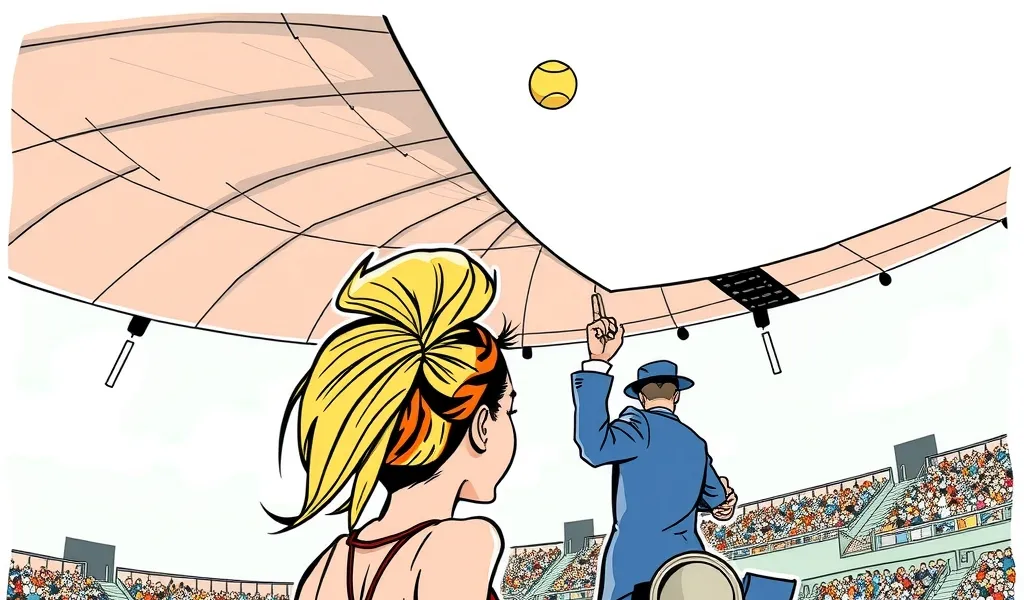
On Friday we noted that Aryna Sabalenka would wake up on Monday ranked No. 2 in the world whether or not she won the US Open final, and that this was, on its face, an absurd sentence. On Saturday the tennis removed the absurdity by removing the whether. She lost. 6-4, 5-7, 6-2, to Elena Rybakina, in two hours and twenty-one minutes. No three-peat. No trophy. No ranking. And then, because this is how the sport works, a microphone.
“That’s the last thing I want to do now is giving a speech.”
She gave one anyway. It was three sentences long and she cried through all of them, and the middle one — “I wish I could perform a little better, but maybe next year” — is going to follow her around until she wins this thing again, which, on the evidence of the last two years, she will.
The Match
Rybakina broke early in the first set, for 3-2, and held the break while landing only 27 percent of her first serves, which is the kind of number that usually loses you a set and on Saturday did not. In the second she served far better, wasted two break points, and — serving at 5-5 — saved two set points before Sabalenka broke her two games later to level the match. That was the moment. That was Sabalenka’s match to take.
She did not take it. Rybakina broke for 2-1 in the third, broke again for 5-2, dropped three points on her own serve in the entire set, and closed it with her twelfth ace. The last set of a Grand Slam final between the two best players in the world lasted about as long as it takes to read this article, and one of them was not really in it.
The Ball
The moment the crowd will remember from the first set was not a point. It was a changeover.
At a first-set changeover, Sabalenka crushed a ball into the stands. The chair umpire issued a warning for ball abuse. Nobody was hit. Nobody, per the tournament’s now well-established standard, was defaulted, or asked whether they were fine. It was a warning, and it was deserved, and it was also the first visible sign that the two-time defending champion was not entirely in control of the afternoon — which, when the opponent across the net is Elena Rybakina, is the whole game. Rybakina does not give you anything. You have to be steady for two and a half hours and hope she blinks first. Sabalenka blinked in the first set and spent the rest of the match trying to un-blink.
By the third set the chair was talking to the crowd more than to the players, repeatedly asking spectators for courtesy and to switch off their camera flashes as Sabalenka struggled — a small, telling detail in a fortnight that has been about the crowd more than the tennis, and the last time this crowd will be asked to behave until next August.
The Winner
Rybakina came into the tournament having retired injured in Cincinnati a few weeks earlier. She said afterward that she had not expected “anything like this,” that she had been “dealing with an injury but somehow everything aligned together on my side.” She is now the world No. 1, the first player from Kazakhstan to hold it, with three majors and — after Melbourne in January — both hardcourt Slams in a single season, which only a handful of women have ever done.
She said the right thing about her opponent: “I want to say to Aryna, you are a great champion. It’s so difficult to play you. I was diving around on court trying to get balls back.” And then she said the thing that, if you have been following this tournament, lands a little differently:
“I’m falling in love with New York more and more.”
This is the woman whom Arthur Ashe Stadium screamed through Gauff’s overhead against on Thursday and then walked out on before her interview. Two days later she is holding the trophy, telling the same building she is falling in love with it. Either she has a very short memory, or a very long one and an excellent sense of timing. Rybakina’s face, as ever, gave no indication of which.
The Ceremony
The trophy presentation itself came in for criticism — “a disaster,” per one widely shared assessment — for its format: on-court interviews with two players, one of whom was in tears and had just said she did not want to speak, conducted at length in front of 23,000 people who had also, by that stage, had a long day. It is a fair criticism. It is also the same ceremony every year, and the reason it looked awkward on Saturday is that the tennis had produced a genuinely awkward result: the better player over two weeks losing to the better player over one, with the ranking having already made up its mind.
Sabalenka, by the press conference, had found her footing: “Overall, I should be happy with the level I played, and there are lots of things to take from this tournament.” She held the ranking for ninety-nine weeks. She will be back at No. 1 before long, and she will be back in this final, and one day she will get to give the other speech.
Maybe next year.
Sources:
- 2026 US Open results: Elena Rybakina upsets Aryna Sabalenka to claim third grand slam — CBS Sports
- Rybakina halts Sabalenka’s three-peat bid to capture first US Open title — WTA
- Elena Rybakina defeats Aryna Sabalenka in US Open women’s singles final — Al Jazeera
- Elena Rybakina sends message to emotional Aryna Sabalenka after beating her in the US Open final — Yahoo Sports
- “A disaster” — US Open under fire from fans for ‘awkward’ Elena Rybakina & Aryna Sabalenka interviews in presentation ceremony — Sportskeeda