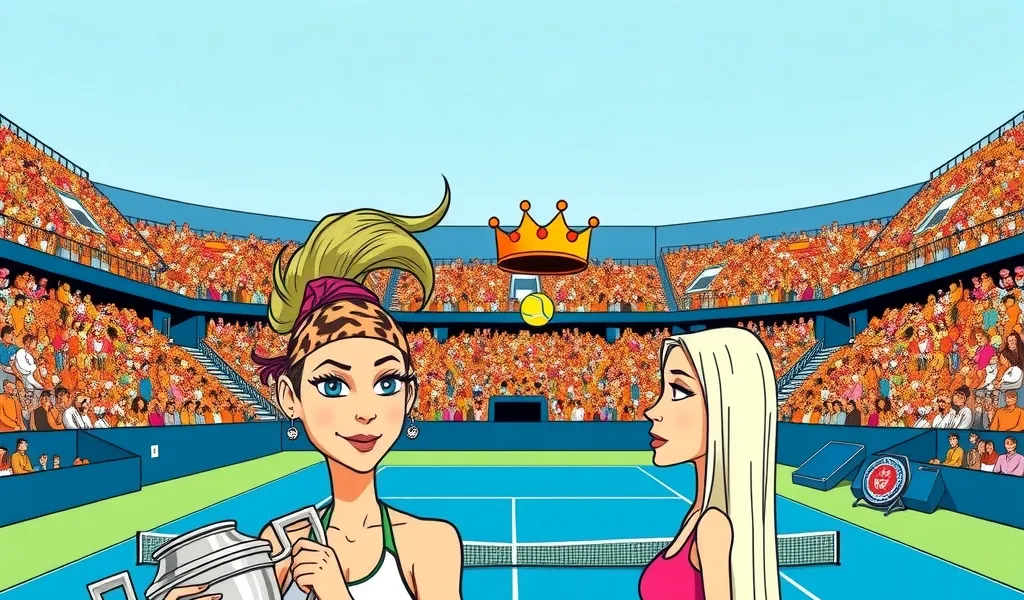
Here is a sentence that should not be possible, and is: on Saturday afternoon, Aryna Sabalenka will walk onto Arthur Ashe Stadium as the world No. 1, the two-time defending champion, and the favorite to become the first woman to win three straight US Opens since Serena Williams — and on Monday morning, regardless of whether she does any of that, she will wake up ranked second in the world.
She could win in straight sets. She could lose in straight sets. She could win a fifty-shot rally to save match point and lift the trophy at sunset with a tiger-print headband and a Kazakh flag being waved somewhere in section 312 in protest. Monday: No. 2. The computer has spoken. The computer spoke on Wednesday, actually, when Elena Rybakina beat Zheng Qinwen in the quarterfinals and clinched the top spot for the first time in her career, and the computer does not care that the two of them then have to play a Grand Slam final against each other with the question already answered.
The Numbers
Sabalenka has held No. 1 for ninety-nine consecutive weeks. That is just under two years. It began in the autumn of 2024 and it survived a great deal — an Australian Open final loss to this exact opponent in January, a spring in which she and Rybakina traded finals in Indian Wells and Miami, a summer that included, by this publication’s count, one press-conference blowup, one on-court request that the crowd stop smoking weed near the baseline, and one very gracious thank-you to a stadium that did not deserve it.
Rybakina, for her part, has beaten Sabalenka in their last two big finals — the WTA Finals last November and Melbourne in January — and lost the two after that. Their head-to-head is 10-7 to Sabalenka. They have split two Grand Slam finals, both in Australia. Saturday is the third, and the eighteenth meeting overall, and the first in which one of them has already been declared the better player by an algorithm before the coin toss.
The stakes are otherwise straightforward and enormous. Sabalenka: the three-peat, last done here by Serena from 2012 to 2014. Rybakina: both hardcourt majors in the same season, which only five women have managed since 1988. The champion takes home $5.5 million. The runner-up takes home $2.8 million and, in one case, the No. 1 ranking anyway.
The Quotes
Both players have been asked about this and both have said, in effect, nothing, which is the correct amount to say.
Sabalenka, on Rybakina: “If it’s Elena, it’s going to be a really tough match. She’s a big server and improved on baseline play.”
Rybakina, on Sabalenka: “She’s very aggressive and difficult to play against, mentally and physically, with her big serve.”
These are the same sentence with the names swapped. It is a testament to the professionalism of both women that neither has pointed out the obvious, which is that the ranking system has produced a final in which the loser might be the world No. 1 and the winner might not be, and that this is, on its face, ridiculous.
Why It Happens
The WTA ranking is a rolling 52-week total. Points you earned last September fall off this September. Sabalenka is defending a title — 2,000 points, the maximum — and can only tread water. Rybakina, defending far fewer points from last September, has been adding. By the time Rybakina reached the quarterfinals, the math had closed: she had more points on Monday’s ledger than Sabalenka could have on Monday’s ledger even with the trophy. Winning the final changes the trophy count. It does not change the ledger.
This is not a flaw, exactly. The ranking measures a year, not a fortnight, and over the year Rybakina has been the better player by the system’s lights. But it does produce a Saturday in which the incumbent can do everything asked of her and still hand over the crown, and a Monday in which the new No. 1 may be introduced as such while the woman who just beat her in a Grand Slam final applauds from the runner-up podium.
Who Deserves To Be Rooting For Whom
The New York crowd, which has spent two weeks being the story, now faces its final exam: a championship match with no American in it. Its options are the reigning champion who thanked it for its manners, and the new No. 1 whom it screamed through an overhead and abandoned before her interview. On the merits it owes Rybakina an apology and Sabalenka a thank-you note, and the likeliest outcome is that it will be loud for both, at the wrong moments, and go home early.
Jessica Pegula, who lost to Sabalenka in the semifinal and is therefore an expert witness, called that match “probably the best match she’s played this year.” Rybakina, meanwhile, came through Gauff in three sets and the stadium in one. Two players in form. One trophy. One ranking. And the strange, quiet knowledge, shared by both of them and nobody else on the court, that the second of those was settled on Wednesday and the first is all that’s actually left to play for.
Which, come to think of it, is the only thing that was ever supposed to matter.
Sources:
- Aryna Sabalenka vs. Elena Rybakina: Everything to know about the US Open final — WTA
- US Open 2026: Aryna Sabalenka and Elena Rybakina promise a final for the ages in battle of world number ones — Olympics.com
- A day after securing World No. 1, Rybakina holds off Gauff to reach US Open final — WTA
- Experts’ picks: Who will win the US Open women’s title? — ESPN
- US Open Tennis 2026 Women’s Final Schedule, Bracket Prediction and Prize Money — Bleacher Report