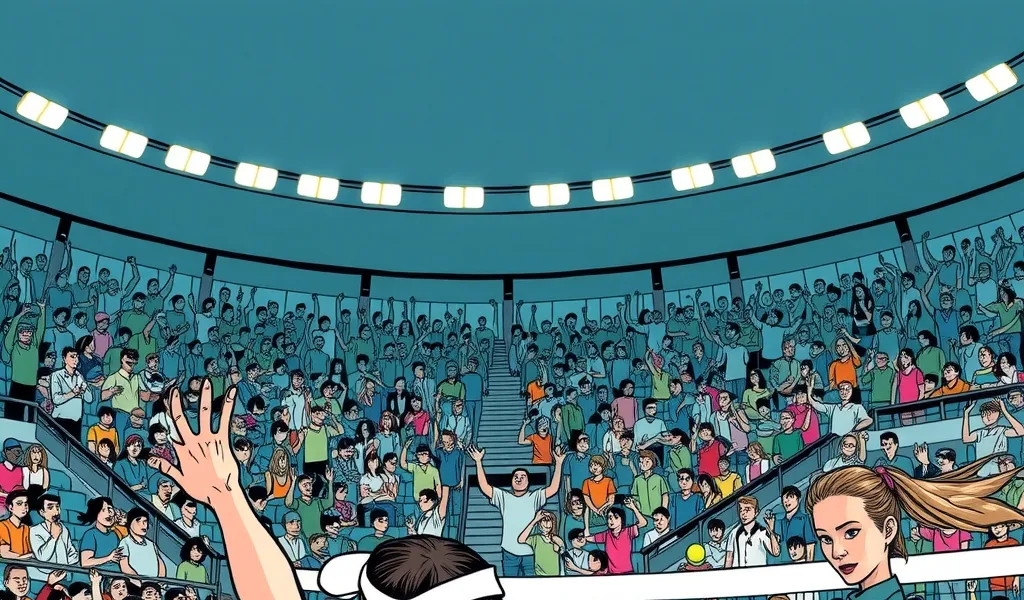
There is a specific sound a tennis stadium makes when it is trying to help. It is not a cheer. A cheer comes after the point. This comes during — a rising, involuntary howl from twenty thousand people who have collectively decided that if they are loud enough at the right moment, the ball will go where they want it to. It has never once worked. It does not stop them.
On Thursday night at Arthur Ashe Stadium, in the third set of the semifinal between Coco Gauff and Elena Rybakina, with Gauff serving to stay in the match, a lob went up. Gauff set up under it for an overhead — the shot every player practices ten thousand times precisely so that it becomes automatic, so that it can be executed with no thought at all, so that it does not matter what is happening around you.
Twenty thousand people screamed. The overhead went long. Rybakina won, 3-6, 6-4, 6-4.
The Yikes
Tennis journalist José Morgado, watching from the press seats, posted the sentence that will stand as the match report: “20k screaming while Gauff was trying to hit that last overhead. Yikes.”
It is worth being careful here, because the internet was not. Gauff did not lose the match because of the noise. Rybakina had served for it at 5-3 and Gauff had broken back, which is not the tennis of a player being blown off court by her own supporters. The match was competitive to the last point. But the last point was an overhead hit into a wall of sound produced by the people who most wanted her to make it, and that is not a detail — that is the whole problem with the way this crowd has behaved for two weeks, compressed into one shot.
“Why the US crowd always scream during points,” one fan wrote afterward. “That 100% messed up Coco on that smash.” The first sentence is the question of the tournament. The second is unprovable and everyone believes it.
The Other Half
What happened next was, if anything, worse, because it was not a reflex.
Rybakina is the new world No. 1 — she clinched it on Wednesday with her quarterfinal win over Zheng Qinwen, and she is the first player from Kazakhstan ever to hold the ranking. She had just beaten the home favorite in three sets in the semifinal of a Grand Slam. What she got, by multiple accounts, was a stadium standing up and filing toward the exits before her on-court interview had begun. Minimal applause. A few thousand people watching the No. 1 player in the world thank a building that was emptying.
“Great match. Crowd frankly disgraceful. Felt so sorry for the victor,” one viewer wrote. Another: “How embarrassing! Fans just stood up and walked off when Coco lost. No clapping for Rybakina.”
Rybakina, whose entire public persona is an absence of visible reaction, did not visibly react. It is possible she did not notice. It is more likely she noticed and had decided, some years ago, that noticing was not her job.
The Contrast
The cruel part of Thursday is that the same crowd had, a few hours earlier, been thanked for its manners.
Aryna Sabalenka beat Jessica Pegula in the first semifinal, 7-5, 6-2, in front of a stadium that wanted Pegula to win and made no secret of it. Sabalenka’s on-court interview included a line that, in hindsight, reads like a test the crowd was about to fail:
“You wanted her to win, it’s obvious, but thank you for being so respectful.”
Respectful. In the afternoon, against the world No. 1 of the last two years, beating an American, the crowd was respectful enough to be thanked for it. By the evening, against the world No. 1 of this week, beating an American, it was screaming through an overhead and leaving before the handshake had cooled. Same building. Same seats. Different American, apparently, and a different hour, and — this is the part nobody wants to say — a different amount of whatever people had been drinking since four o’clock.
The Pattern
This is the third time this fortnight that the crowd has been the story, and the three stories do not point in the same direction. In the first week it was the influencers in the suite, and the crowd was the victim. On Sunday it was the hecklers on Louis Armstrong, and the crowd was the hero, chanting “kick them out” until security did. On Thursday it was twenty thousand people screaming at a lob, and the crowd was — there is no other word — the villain, and not to the visitor, but to the woman it was trying to help.
The US Open sells itself on this. The noise, the New York of it, the fact that this is the Slam where the crowd is allowed to be a participant. That pitch has been made for thirty years and it is not wrong; it is why the night sessions sell out at prices that would make a Broadway producer blush. But a participant is someone who affects the outcome, and on Thursday the participants affected the outcome, and it was not the outcome they wanted.
Saturday’s final is Rybakina against Sabalenka. New No. 1 against old No. 1. No American in it. The crowd will have to decide who it is for, and — for the first time in two weeks — nobody will be able to blame it for the result.
Sources:
- ‘How Disrespectful’ – Coco Gauff and Elena Rybakina’s ‘Rude’ Treatment by US Open Crowd Angers Tennis World — Yahoo Sports
- Tennis Fans Slam US Open Crowd Over Disrespectful Conduct During Elena Rybakina-Coco Gauff Clash — Yahoo Sports
- The crowd wanted Coco Gauff but got Elena Rybakina instead — CNN
- Elena Rybakina beats Coco Gauff and will play Aryna Sabalenka for the US Open women’s title — NBC Sports / AP
- Sabalenka, Pegula, Gauff and Rybakina: Thursday at the 2026 US Open — usopen.org