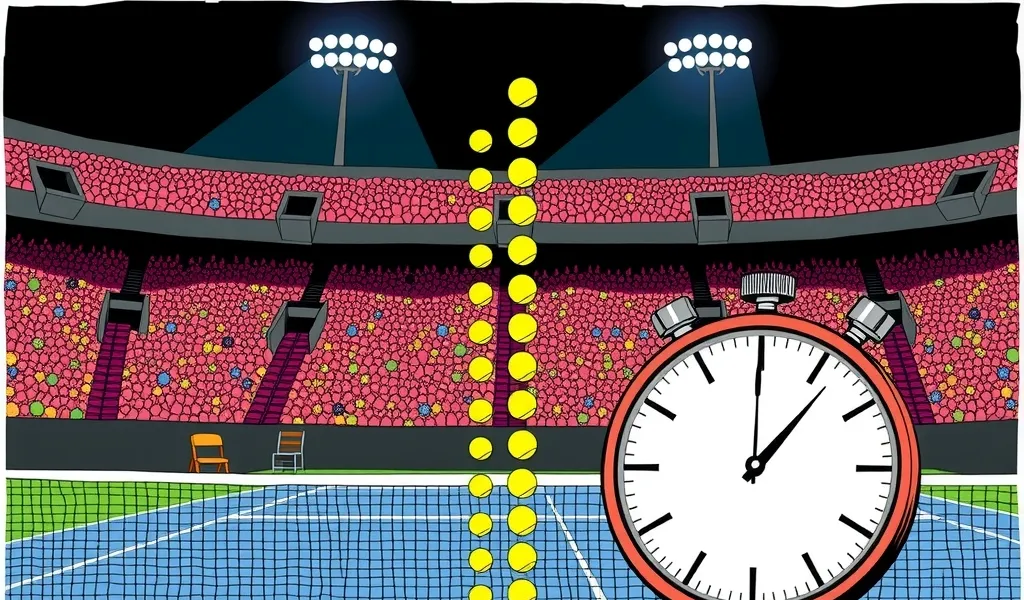
The story of the 2026 US Open men’s champion has, within a week, stopped being about the champion. Alexander Zverev won the title on Sunday, beat Ben Shelton for a sixth straight time, and is now within striking distance of the No. 1 ranking. Nobody is talking about any of that. They are talking about what he does with the ball in the seconds before he hits it, which — by one broadcast count over the fortnight — he did more than twelve thousand times.
Here, in the order they spoke, are the four men who have made it a controversy.
The Semifinalist
Karen Khachanov lost to Zverev in straight sets on Friday and went to his press conference with a specific grievance. Not that Zverev bounces the ball. That he bounces it unpredictably.
“You don’t know how to prepare for the serve. You’re ready. Then it’s another twelve bounces.”
This is the receiver’s complaint, and it is a real one. A returner sets his feet when he thinks the serve is coming. If the server then bounces the ball a dozen more times, the returner has to hold a loaded position, or reset, or guess — and the whole point of a serve routine is that it should be a routine, which is to say the same length every time. Khachanov was careful to note that all of it was within the rules. That was the complaint.
The Finalist
Shelton, on Sunday, said the rule was stupid. He was told by the chair to get to the line quicker while Zverev bounced; he proposed a time limit on second serves; he did not accuse Zverev of anything. “He never does less than ten bounces. I’m always going to be ready when he’s ready to serve.”
The Former Champion
Andy Roddick — 2003 champion, last American man to win here, and the owner of the loudest microphone in American tennis — went further, and went first, on the Saturday before the final:
“You cannot bounce the ball twenty-something times between first and second serve.”
And the fix: “There needs to be a shot clock for the second serve.”
Roddick’s argument is the important one, because it is not about Zverev. It is about the rulebook. The twenty-five-second clock runs between points; between a first-serve fault and the second serve there is no clock at all, only the word “without delay,” which is enforced by whoever is in the chair and was not, in the final, enforced until the fourth set. Roddick’s point is that a player will exploit an ambiguous rule every time, not because he is a villain but because he is a professional, and the way to stop it is to make the rule unambiguous. “Yeah, the rules should change.”
The Five-Time Champion
Then, on his podcast this week, Jimmy Connors — five US Opens, the most combative man ever to hold a racquet — declined to join the mob, on the grounds that he was once the mob’s target.
“I was a bouncer too, and I had a number. I had OCD — it could be superstition or whatever — but I counted a lot of the times.”
He had counted Zverev, too: “He was always between eight and eighteen, somewhere between there. Sometimes he was nine and sometimes it was seventeen.”
And his advice to the returners of the world, which is the most Jimmy Connors sentence produced this year:
“I never let what my opponent did bother me, so don’t let what I do bother you.”
This is not a defense of the rule. It is a defense of the player — the idea that a pre-serve ritual is a nervous system doing what it needs to, that everyone has one, and that the returner’s job is to be ready whenever, not to be ready on schedule. It is also, coming from Connors, a little rich: this is a man who spent two decades making sure his opponents were bothered by everything he did. But he is not wrong that the ritual is real. Zverev himself, asked why, said: “I have no idea why. I don’t do it on purpose.”
Where That Leaves It
Four voices, and the split is clean. Khachanov, Shelton, and Roddick want a rule — a clock on the second serve, or a bounce limit, or something an umpire can point at. Connors wants the returner to grow up. Sports Illustrated has already dubbed Zverev “NYC’s next big villain,” which is what happens to a foreigner who beats an American in the final at a volume the crowd could not drown out.
The truth, as usual, is that both camps are right and neither will win. The rulebook will not add a second-serve clock this year. The returners will keep complaining. And Zverev will keep bouncing the ball somewhere between eight and eighteen times, sometimes nine, sometimes seventeen, because that is the number his hands need, and because, more often than not this fortnight, the serve that followed went in.
Sources:
- Jimmy Connors tells Alexander Zverev’s opponents how they should respond to his ball bouncing before serving — Yahoo Sports
- “You cannot do it”: Andy Roddick backs Khachanov’s complaint over Zverev’s ball bouncing — Tennis Up To Date
- Andy Roddick proposes ‘crazy’ rule change after watching Alexander Zverev at the US Open this year — Tennishead
- Alexander Zverev, NYC’s Next Big Villain, Has a Controversial Serving Move. Should It Be Allowed? — Sports Illustrated
- Alexander Zverev opponents told how to stop controversial tactic Andy Roddick wants banned — SPORTbible