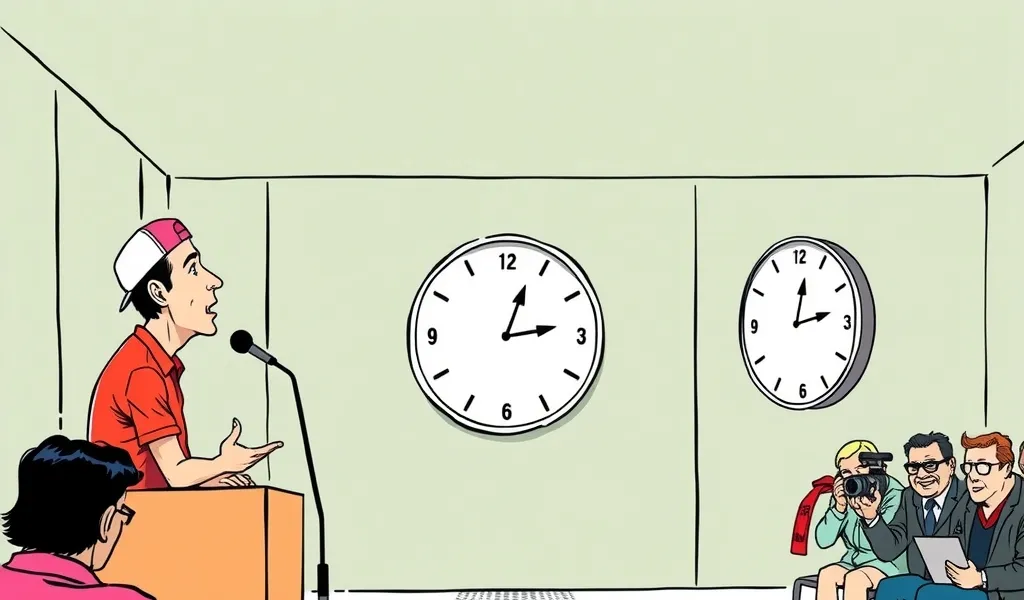
The most interesting thing Ben Shelton said on Sunday was not on the court, where he lost the US Open final in four sets, and it was not at the trophy ceremony, where he told Alexander Zverev “you’re one of the very best players in the world, maybe the best player in the world this year,” which was gracious and, on the year’s evidence, correct. It was in the press room afterward, where a reporter asked about the thing everyone in the building had been watching for three and a half hours, and Shelton — tired, beaten, and entirely lucid — laid out a rules complaint so reasonable that the sport should be embarrassed it took a losing finalist to make it.
The Routine
Zverev bounces the ball before he serves. Everyone does. Zverev does it a lot — sometimes ten, sometimes a dozen, sometimes, per ESPN’s count, nearly twenty — and he does it on second serves especially, and by one broadcast tally he had done it more than twelve thousand times over the fortnight. Shelton, during the second set, went to the chair about it twice. The chair — Marijana Veljović, whom regular readers will remember standing between Tiafoe and Faria at the net in Paris — did not warn Zverev. What she did instead, at some point, was tell Shelton to get to the line quicker.
Read that again. The receiver complained that the server was taking too long. The umpire’s response was to tell the receiver to hurry up.
The Rule
This is, absurdly, correct under the rules. The shot clock at a major is twenty-five seconds, and it governs when the server must begin — but once the server has begun the routine, the rulebook says the receiver must play to the server’s reasonable pace and be ready when the server is ready. The umpire’s job is to make sure the receiver is at the line. The umpire’s job is not, in any enforceable way, to decide that nearly twenty bounces is unreasonable. There is no bounce limit. There is no “reasonable pace” number. There is a man at the baseline, bouncing, and a man at the other baseline, who has been instructed to stand there and wait.
Shelton, afterward:
“He can start his routine whenever he wants. But I shouldn’t have to sit at the line. I think that is a stupid rule, that you got to be sitting there.”
And then, because he had clearly been thinking about it for longer than one afternoon, the actual proposal:
“I definitely think for first serve, you should be able to do whatever you want. I think that there should be some sort of rule limiting time on second serve.”
That is a sensible rule. It is more sensible than the current rule. It distinguishes between the first serve, where a long routine is a player’s rhythm, and the second, where it is a player’s nerves — and where the receiver, having just watched a fault, is being asked to hold a ready position for as long as the server needs to settle himself. The ATP has a clock for the gap between points. It does not have one for the gap between serves. Shelton is suggesting that it should. He is the second-best player in the tournament, he just lost to the routine in question, and he is proposing a change that would have helped him. All of that is true, and none of it makes him wrong.
What He Did Not Say
He did not say Zverev was cheating. He went out of his way not to:
“He never does less than ten bounces. I’m always going to be ready when he’s ready to serve.”
Zverev, asked about the routine, said: “I have no idea why. I don’t do it on purpose.” Which is almost certainly true, and is also the entire point. The rule does not require intent. It requires only that the server take as long as he takes, and that the receiver wait. A man who bounces the ball nearly twenty times because his hands need to is, under the current rulebook, indistinguishable from a man who does it to make his opponent stand still, and the umpire is instructed to treat both the same way, which is to say: tell the other guy to get to the line.
Veljović did, eventually, warn Zverev for pace — in the fourth set, by which point the match was a formality and the warning was a footnote. Shelton did not bring that up. He did not need to.
The Loser’s Privilege
There is a genre of post-final press conference in which the loser complains about the officiating, and it is not a flattering genre, and Shelton knew it. So he did the other thing first. He said walking out on Ashe was “such a cool moment” and that “there’s nothing like it.” He called the winner the best player of the year. He thanked God and said the losses were a gift. He gave Zverev every inch of the moment.
And then, having paid for the privilege, he said the rule was stupid. Calmly. With a proposal attached. In the one room where a beaten player’s opinion about the rules is guaranteed to be printed.
Zverev, for his part, told the crowd: “I know today 99.9 percent of the people wanted Ben to win, so I’m very sorry first of all.” He also said that in the biggest moments he “didn’t hear noise at all,” which is the sound of a man who has been bouncing the ball through hostile crowds for a decade and has made his peace with the arrangement.
The rule will not change this week. It may not change this year. But somebody is going to bring Shelton’s proposal into a players’ council meeting, and when they do, they will have a US Open final to point at, and a chair umpire telling the receiver to hurry up.
Sources:
- ‘Stupid Rule’ – Ben Shelton Details His Dispute With US Open Umpire Over Alexander Zverev’s Controversial Habit — Yahoo Sports
- Zverev dashes American hopes, beats Shelton in US Open final for 2nd major — ESPN
- Ben Shelton loses U.S. Open final to Alexander Zverev — The Washington Post
- Alexander Zverev overtakes Ben Shelton to win U.S. Open final — NBC News
- Alexander Zverev defeats Ben Shelton to win 2026 US Open — usopen.org