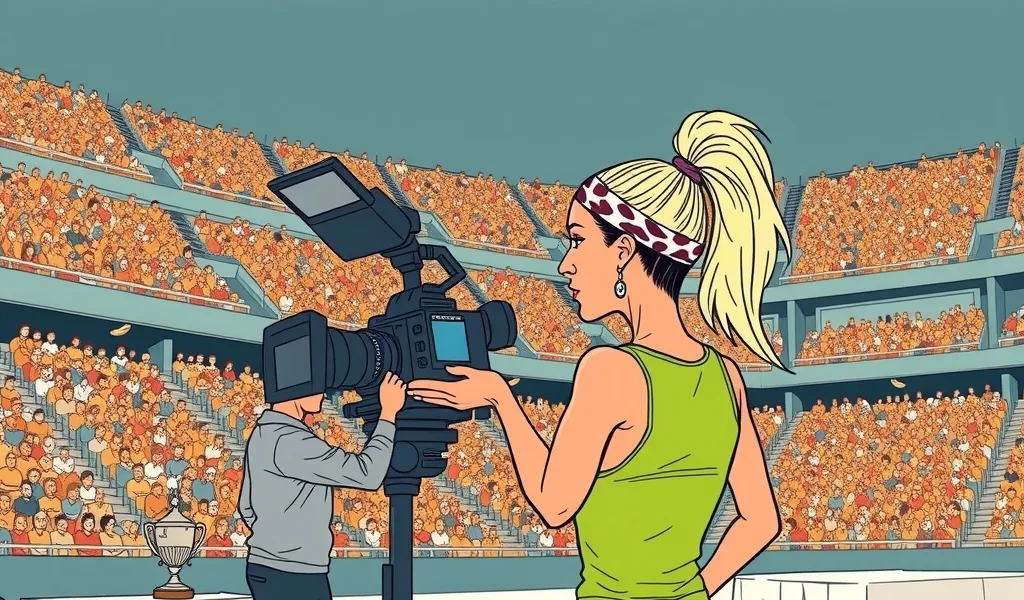
The final point of the 2026 US Open women’s final was a Rybakina ace, her twelfth, and what followed it took perhaps ninety seconds. In that time Aryna Sabalenka smashed her racquet into the court — a code violation, her second of the afternoon, issued to a player who no longer had a match to be penalized in — sat down beside her fiancé in the courtside seats, was put on the stadium’s big screen, noticed the camera operator who had put her there, waved him off, and, on a clip that had gone around the world before the trophy was out of its box, said:
“F**k off.”
Then she stood up, walked to the microphone, cried through three sentences, and told twenty-three thousand people maybe next year.
A Fortnight, In Equipment
It is worth laying the whole two weeks out, because Sabalenka has been the most consistently newsworthy person at this tournament for reasons that, until Saturday afternoon, had almost nothing to do with the tennis — which she was playing, by everyone’s account including her opponents’, better than anyone.
In the first week she was asked by a reporter how her mood was “now that the tournament has started, obviously last week it’s lots of parties and fun,” and responded with “you guys are like a joke,” “you literally said that,” and “think before you say stuff.” Two days later she stopped a third-round match to ask the crowd — “you can smoke whatever, you can relax as much as you can” — to please not do it near the court. In the semifinal she beat Pegula and thanked a stadium that wanted the other woman for being “so respectful.” In the final she took a ball-abuse warning in the first set for crushing a ball into the stands. And after the final, the racquet, the camera, and the two words.
Every one of those moments involved a piece of media equipment: a press-room microphone, an on-court microphone, a courtside camera. She is, this fortnight, the most-recorded woman in tennis, and the record shows a person who does not especially enjoy being recorded at the moments she is being recorded.
The Reaction
The internet’s verdict was fast and not kind. “Sore loser as always. She needs to grow up.” “Aryna’s greatest enemy is Aryna. This is just plain rude.” “She needs lessons from Carlos in how to lose with grace.” And the one that stung, because it was about the winner: “Disrespectful and completely self-absorbed. She can’t give Elena her moment.”
There is a version of this that is fair and a version that is not, and they are the same facts.
The unfair version: a player who has just lost a Grand Slam final, a three-peat, and the No. 1 ranking she held for ninety-nine weeks — in the space of one afternoon — is sitting with her partner, trying to breathe, and a camera is pushed toward her face so that her lowest moment can be shown at thirty feet tall to the people who paid to watch her lose. Telling that camera to go away is not sportsmanship. It is not un-sportsmanship either. It is a human being asking for a second.
The fair version: the racquet smash came while Rybakina was celebrating, and the camera came after, and the two together read — in the stadium and on every phone in it — as a champion who could not let the other woman have the frame for even a minute. Rybakina, who had been screamed through an overhead and walked out on two nights earlier, stood there holding a trophy while the story was, again, somebody else.
The Walk-Back
By the press conference Sabalenka had done what she always does, which is say the true thing plainly.
“It’s really tough to control your emotions when you lose in a final of a Grand Slam and when you were trying to go for a three-peat. If I were to hold it inside, right now or on the court, I wouldn’t be able to say a word. I wanted to let go of all that aggression and disappointment outside.”
That is not an apology. It is an explanation, and a good one — the racquet and the two words were the price of the speech. She could not have given the one without the other. You may think that is a bad trade. She has clearly decided it is the only one available to her, and the evidence of the fortnight is that she is right about herself.
Then she said the thing about the winner that she could not say at the microphone:
“We have a great rivalry. We played a lot of great matches and finals this season. Her serve is amazing. The way she’s able to step in and overpower you — a lot of things make her dangerous.”
And, on the ranking she had just lost: “If she continues playing like that, I’m in trouble.”
The Pattern, One Last Time
At Roland Garros in May, Novak Djokovic, changing his shirt between sets of a match he was about to lose to a teenager, looked into a camera that had crept too close and said, “Can you come more in my face? For god’s sake, make some space.” We wrote about it at the time as a small, compressed moment of a great player under pressure. Saturday was the same moment, two words shorter.
The cameras will not move back. They are the reason the night session starts at seven and the prize money is a hundred million dollars and the suite behind the umpire’s chair is full of ring lights. The players know this. Sabalenka knows it better than most; she has spent two weeks being the best thing on them. She just also, at the end, wanted one second in which she was not, and the lens did not give it to her, and she said so.
Next year the camera will be in the same place. So, very probably, will she.
Sources:
- ‘Disrespectful’ – Aryna Sabalenka’s ‘Rude’ Outburst at Cameraman Draws Fan Backlash After US Open Final Loss — Yahoo Sports
- Aryna Sabalenka Fires F-Bomb Before Heaping Praise on Elena Rybakina After US Open Loss — Yahoo Sports
- ‘Sore loser’ — Aryna Sabalenka causes controversy over two things she did after US Open final loss to Elena Rybakina — SPORTbible
- “All that aggression & disappointment” — Aryna Sabalenka clarifies controversial moment after US Open final with racket smash — Sportskeeda
- US Open: Sabalenka dethroned by Rybakina — “If she keeps playing like this, I’m done” — Tennis Temple