On Monday this publication ran a piece about the US Open night session, noting that of the first six nights, three had ended after 2 AM and that the tournament’s response, for the third consecutive year, was to keep evaluating. We closed with the observation that it is hard for New Yorkers to still be in the building at two.
We did not consider three-thirty. The tournament did.
At 3:33 in the morning on Wednesday, Ben Shelton hit the last ball of a four-hour-and-twenty-eight-minute quarterfinal against Carlos Alcaraz, and the latest finish in the 145-year history of the United States national championships was on the books. The previous record — Alcaraz against Jannik Sinner, 2:50 AM, the 2022 quarterfinals — had stood for four years. It fell by forty-three minutes. It fell to the same man, standing on the other side of the net this time, losing.
The Match
Let it be said first: the tennis was extraordinary. Shelton, the eighth seed, took the defending two-time champion to a fifth set and then to a ten-point tiebreak, and won it, 6-7(5), 6-1, 6-3, 1-6, 7-6. He ended Alcaraz’s eighteen-match winning streak at Grand Slams. He put an American in the semifinal against another American — Frances Tiafoe, who had come back from two sets down against Alex Michelsen on the same court the same afternoon — for the first all-American men’s semifinal at Flushing Meadows in a generation, with a shot at the first all-American final in more than two decades.
Alcaraz, who had missed four months with a wrist injury and come back to reach this stage anyway, was gracious in the way he tends to be: “I leave the court with a smile. I am proud of myself, how I fought. He knew exactly what to do at every moment. And, physically, he’s a beast.”
Shelton called it “a war, epic match, so physical,” and “the most enjoyable match that I’ve had in my career, for sure.”
All of that is true and none of it is why you are reading this.
The Clock
Here is how a tennis match ends at 3:33 in the morning.
It starts with a day session. On Tuesday the day session on Arthur Ashe held two quarterfinals — Sabalenka against Nosková, then Tiafoe against Michelsen — and both went the distance, and both went to a deciding-set tiebreak. Three of the four singles quarterfinals played on Ashe that day went to a match tiebreak. That is not a scheduling failure; that is tennis being good. But it is tennis being good for a very long time, and every minute of it pushed the night session later.
The night session then held two more matches. The first was Pegula against Navarro — three sets. The second was Alcaraz against Shelton — five sets, four and a half hours. Add them up and the arithmetic we described on Monday does what it always does. There is no curfew. There is no cutoff. There is no rule that says the last match cannot start after a certain hour. There is only the next match, and the next match starts when the previous one ends, and the previous one ended very late.
So Shelton and Alcaraz walked out at an hour when most of the city was asleep and played until an hour when the rest of it was, too.
The Crowd
Shelton’s on-court interview is worth quoting at length, because he said the nicest possible thing about the situation and in doing so described exactly what was wrong with it:
“Whether it’s my coaches and my team there, all my family and friends here, or the city of New York that showed up tonight till 3 AM with the USA chants until the very end — that’s what kept me going, and that’s what got me this win tonight.”
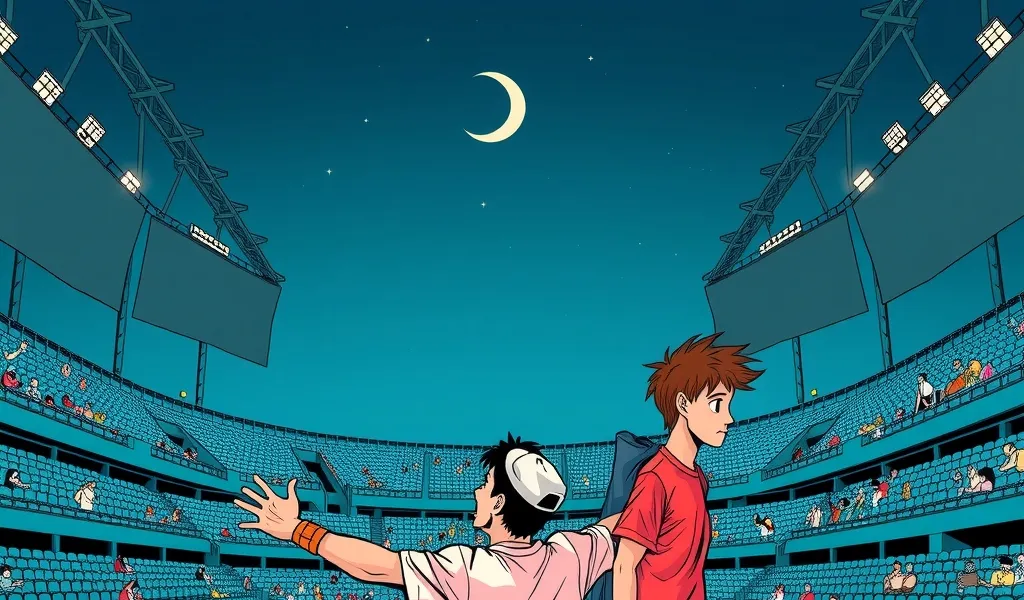
Showed up till 3 AM. Reports describe “thousands” staying to the end, and the chants were real, and the atmosphere in the lower bowl was by every account tremendous. But Arthur Ashe holds nearly 24,000 people, and thousands is the word you use when the number is no longer tens of thousands. The upper deck had gone home. The television audience on the East Coast had gone to bed. The greatest stadium in the world, as Shelton called it — “I always say this is the greatest sports city in the world, I say this is the greatest stadium in the world” — was, for the final and best set of the tournament so far, far closer to empty than full.
That is the deal, stated once more. The night session exists for television. Television had switched off. The match that most deserved a full house got the smallest one of the fortnight, because the schedule that protects the broadcast has no mechanism for protecting the match.
What Happens Now
Shelton plays Tiafoe on Friday. He will have had, by then, roughly two days to recover from a four-and-a-half-hour match that ended at breakfast, which is the kind of turnaround the players were complaining about before the tournament had even produced its record.
The tournament, as of this writing, has said nothing. The line from two summers ago — “it’s hard for New Yorkers to get here even at 7 PM” — presumably still stands. So does the other one: “we’ll continue to evaluate it.”
On Monday we noted that nobody plans for a match to end at 2 AM, but nobody plans against it either. Consider the record now set. Consider it, in the tournament’s phrasing, evaluated.
Sources:
- American Ben Shelton outduels defending champ Alcaraz in latest-ever U.S. Open finish — NBC News
- Ben Shelton shocks Carlos Alcaraz in five sets to win US Open quarterfinal — Al Jazeera
- US Open 2026 results: Ben Shelton stuns Carlos Alcaraz to reach semifinals — CBS Sports
- US Open 2026: Ben Shelton dethrones Carlos Alcaraz in super tiebreak and latest ever finish in tournament history — Olympics.com
- US Open 2026 schedule, bracket, results: Ben Shelton, Frances Tiafoe score massive wins to set up semifinal — CBS Sports