Women’s doubles at a Grand Slam is, in the normal course of things, the quietest tennis on the grounds. It is played on outer courts, in front of people who wandered over from the food court, by pairs who have known each other for years and mostly want to get through the round and go eat. Nobody expects the round of 16 of the women’s doubles to produce the most heated exchange of the tournament’s second week.
Nobody, that is, who has not been paying attention to Jelena Ostapenko.
On Monday, the fourth-seeded pair of Ostapenko and Hsieh Su-wei beat Chan Hao-ching and Maya Joint 6-4, 6-4. That sentence contains everything that happened in the tennis. What follows is everything else.
The Complaint
Partway through the match, Ostapenko and Hsieh began to notice the players’ box on the other side. Specifically, they noticed Chan’s coach. By their account — Ostapenko’s, relayed to the chair umpire — he was clapping after their errors, shouting after their errors, and, in between, praising their winners in Chinese in a tone that Hsieh, who speaks Chinese, translated for her partner as not sincere.
Hsieh went to the chair at a changeover. Ostapenko joined her and pointed at the box.
“They do this because they know they cannot beat us.”
She called it “very disrespectful,” and then made a request that may be a first in the history of Grand Slam officiating: she asked the umpire to bring out a Chinese translator, so that an official could independently verify that the coach was being sarcastic.
Take a moment with that. A player asked a chair umpire to adjudicate tone — in a language the umpire did not speak — by summoning a linguist to the court mid-match. The supervisor was eventually called. Whether a translator ever materialized is unclear. What is clear is that Ostapenko was not going to hit another ball until the record reflected that she had been mocked in a language she does not understand.
The Celebration
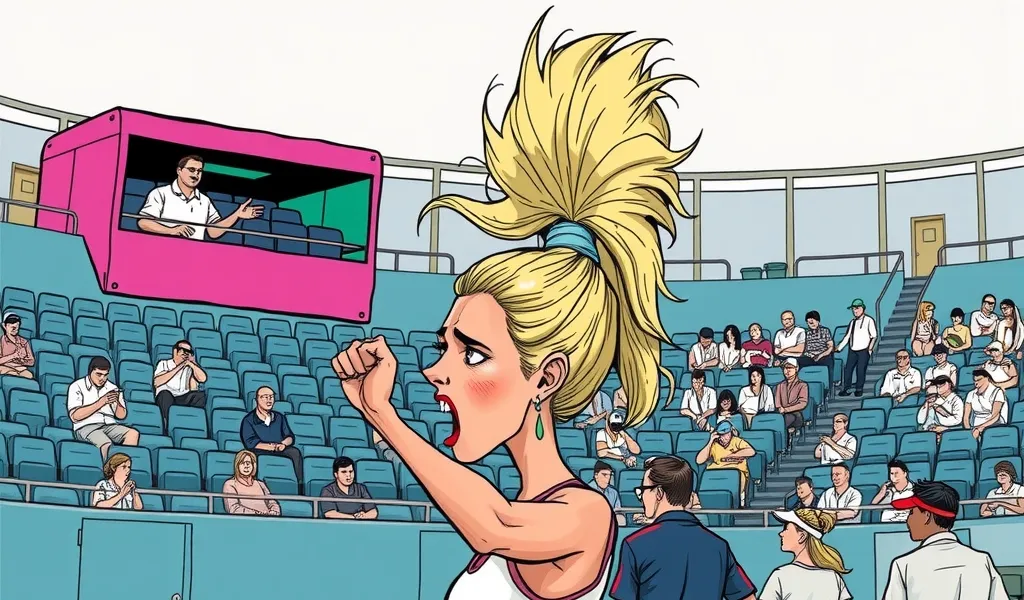
They won. And Ostapenko, who is not a woman to let a grievance expire at the handshake, turned on the final point toward the box she had spent the match complaining about and roared at it. Not the crowd. Not her own box. Theirs. Fists clenched, back arched, the full Ostapenko, delivered directly at a man whose offense was clapping.
It was, depending on your tolerance, either the most cathartic moment of the doubles draw or a 29-year-old former Roland Garros champion picking a fight with a coach. It was probably both.
The Handshake That Wasn’t
Here is where the story stops being about Ostapenko and becomes about something older.
At the net, Chan Hao-ching walked past Hsieh Su-wei without shaking her hand. This was not a reaction to the roaring. This is what these two do. Hsieh and the Chan sisters are among the most accomplished doubles players Taiwan has ever produced, and Hsieh and the Chans have not been on speaking terms for the better part of a decade — a feud rooted, by Hsieh’s account, in her belief that Chan and her sister Latisha received preferential treatment in funding and coaching from the Chinese Taipei tennis federation. There was a withdrawal from the 2016 Olympic doubles. There was a last-minute mixed-doubles withdrawal in 2017 that cost Hsieh’s brother a match. There were refused handshakes in Beijing and Ningbo just last autumn.
So when Chan’s coach clapped at Hsieh’s errors on Monday, he was not clapping at a stranger. And when Ostapenko demanded a translator, she was — whether she fully knew it or not — wading into a ten-year family argument on behalf of a partner who very much did.
The Pattern, Again
Ostapenko’s presence at the center of this is not, strictly speaking, a coincidence. At last year’s US Open she told Taylor Townsend, at the net, after losing, that Townsend had “no class” and “no education.” The clip ran for a week. She has, across her career, feuded with opponents, umpires, and crowds. She is, in the sport’s informal taxonomy, a Character — a designation that is affectionate right up until she is standing at the umpire’s chair asking for a translator.
But it is worth noticing what she was actually asking for on Monday, underneath the theater. She was asking for the rulebook’s prohibition on coaching-box interference — which exists, and which is enforced about as consistently as the cramping rule — to be applied to a man she could not understand. Her method was absurd. Her complaint was not.
The coach clapped. The umpire shrugged. The translator, as far as anyone can tell, never came. And two of the best doubles players in Taiwanese history walked off the same court, in the same direction, without looking at each other, as they have been doing since last autumn.
Sources:
- Jelena Ostapenko yells at opposing coach during heated US Open match — Yahoo Sports / Reuters
- Jelena Ostapenko Yells at Doubles Opponent’s Team As Partner Hsieh Su-wei’s Feud Adds Tension at US Open — Yahoo Sports
- A decade-long feud continues at US Open as Jelena Ostapenko centre of Taiwanese tennis drama — Yardbarker
- Tennis-Ostapenko vents fury on opposing coach after heated US Open doubles clash — SRN News
- Taylor Townsend Says Jeļena Ostapenko Took Classless Dig at Her After U.S. Open Match (2025) — Sports Illustrated