For two weeks the story of the 2026 US Open crowd has been a story about what the crowd does wrong. Ring lights in the suites. Weed drifting over from the park. Booing a man for complaining about grunts. Reports of a fan telling a player to go back to Russia. The tournament nearly doubled its influencer credentials, the ticket prices went vertical, and the consensus in the press room was that Flushing Meadows had become a place where tennis happened in the background of other people’s content.
Then, late on Sunday night on Louis Armstrong Stadium, the crowd did something nobody had a headline ready for. It policed itself.
The Match
Jakub Menšík, the 17th seed, was playing Learner Tien, the young American, in the third round. It was a late session — the kind this tournament has specialized in — and it went five sets. Tien would win it, 6-4 in the fifth, and afterward thank the stadium in the voice of a man who could not quite believe it was still full: “I want to thank everyone for staying this late. I’m very, very grateful for everyone who stayed tonight. Thank you.”
Between the third set and that speech was the part that matters.
The Hecklers
Somewhere in the fourth set, two men in the stands — one in a blue shirt, one in green — decided that the best use of a seat at a Grand Slam was to yell at Jakub Menšík. Not once. Repeatedly, between points, through his service motion, in the specific way that is designed to be heard by exactly one person on the court. Menšík heard. He called them out — pointed, said something, looked to the chair — and play continued.
The heckling did not stop. With Tien serving at 4-3, it continued. And so Menšík did the thing players almost never do, because it costs them rhythm and makes them look thin-skinned and usually accomplishes nothing: he stopped the match. Racquet down. Pointed up at the two men. Waited.
The chair umpire, as far as the record shows, waited too.
The Chant
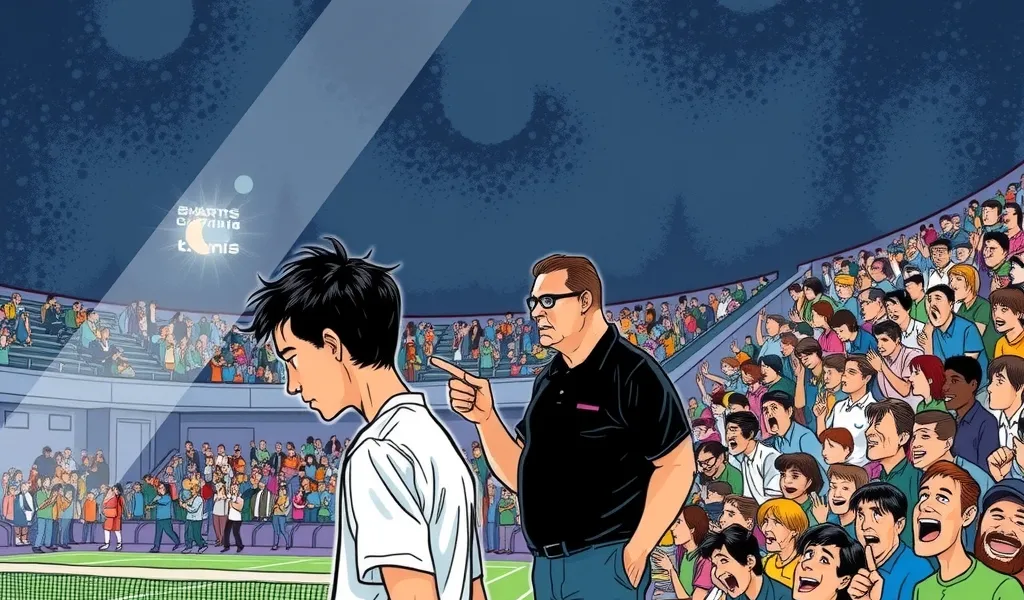
What happened next is the entire story. The people sitting around the two hecklers — the ones who had paid their several hundred dollars, who had stayed past midnight, who had been listening to this for the better part of a set — turned around, pointed at the two men, and began to chant.
“Kick them out.”
Then more of the stadium joined. Kick them out. Kick them out. Louis Armstrong seats about fourteen thousand people and by the sound of it a healthy fraction of them had opinions. Security arrived. The man in the blue shirt was escorted up the aisle, and — this is the detail that tells you everything about the man in the blue shirt — raised both arms in celebration as he went, as though he had won something. The man in the green shirt looked around, did the arithmetic, and left on his own.
Play resumed. Tien served at 4-3. The crowd, having thrown out its own, settled back in to watch the tennis.
What This Means
There is a rulebook procedure for this. A player reports a disruptive spectator to the chair umpire; the umpire alerts the supervisor; the supervisor alerts security; security acts. It is a chain of four people, and on Sunday night the first link in it — the umpire — did not visibly move. The player did the reporting. The crowd did the alerting. Security did the acting. The official in the chair, who has a microphone and the authority to use it, was bypassed by fourteen thousand people who found it faster to handle things directly.
That is not, strictly, how it is supposed to work. It is also, on the evidence of this fortnight, how it now does work. The USTA has spent two weeks saying that chair umpires “have the ability to address the crowd when issues occur.” They do. The Osaka umpire used it. The Menšík umpire, for whatever reason, did not — and the crowd, having watched two weeks of ring lights and weed and no consequences, decided that the ability was theirs too.
Naomi Osaka said something earlier in the tournament, after her own match had been stopped for the suite full of influencers, that reads differently now: “If you come to a sporting event, you have to respect the sport. And I feel like it’s common courtesy to read up on the sport, especially the etiquette.”
The etiquette, it turns out, has a chapter the players did not write. It goes: if the officials will not deal with the man in the blue shirt, the people sitting behind him will. And it is three words long.
Sources:
- US Open crowd calls out drunk fan before ejection after Jakub Mensik’s complaints in five-set defeat — Yahoo Sports
- US Open Crowd Under Fire as Tennis Fans Call Out Heckling and Disrespect — Yahoo Sports
- WATCH: US Open fan kicked out of stadium by security for repeatedly heckling Learner Tien’s opponent Jakub Mensik — Sportskeeda
- Full sequence of events re heckling fans — Lukas Weese, X
- Influencers, weed and disruptions stir controversy at U.S. Open — KTLA