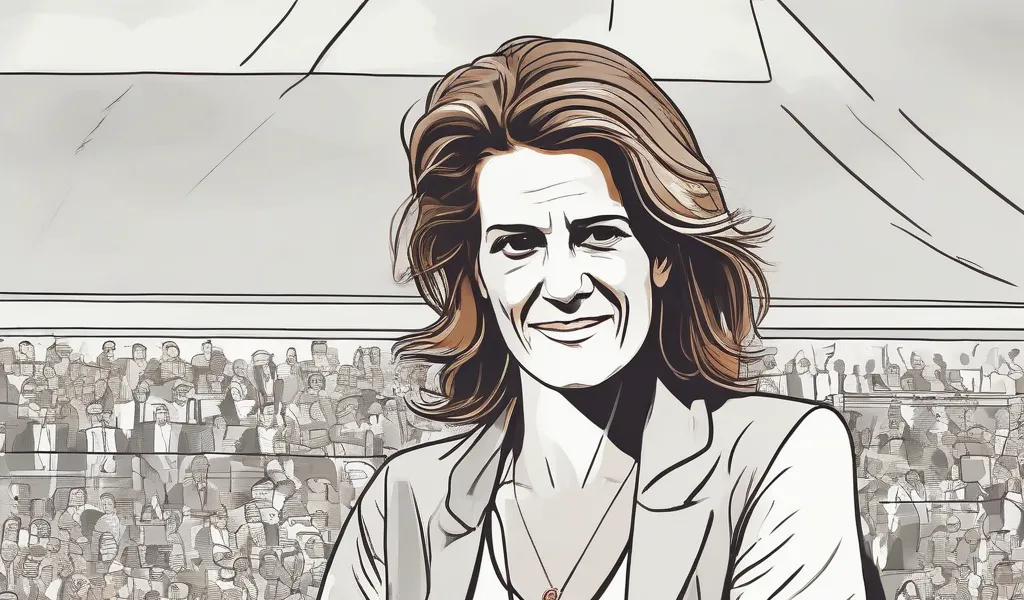
On Wednesday, May 21st, 2026, Roland Garros tournament director Amélie Mauresmo was asked a direct question: would the French Open be making any changes to its prize money structure in response to growing player unrest?
Mauresmo did not hedge. She did not say “we’re exploring all options” or “we take player concerns very seriously and will continue to engage in constructive dialogue.” She said five words, in French, that translate to:
“There, we’re not going to move.”
This was, by any measure, a decisive statement. A line in the clay. A declaration from an institution that has been running a tennis tournament since 1891 and was not, thank you very much, about to be told what to do by a group of people who are merely the reason the institution exists.
Twenty-four hours later, the French Tennis Federation was in a room with player representatives having what both sides described as a “positive and transparent” meeting.
We present, without further comment, a timeline.
Wednesday: Not Going to Move
Roland Garros revenue for 2025: approximately €395 million. Revenue growth year-on-year: 14%. Players’ share of that revenue: 14.3%. Players’ share in 2024: 15.5%. Direction of travel: down.
The players — specifically a coalition of top-ranked men’s and women’s professionals including Jannik Sinner, Aryna Sabalenka, Coco Gauff, and Iga Świątek — had been asking for their share to rise to 22%, in line with what regular ATP and WTA 1000 events pay out. The French Open responded by increasing total prize money by 9.5% to €61.7 million, which would have been impressive news if revenue hadn’t grown nearly 14%, making the raise, mathematically, a cut.
When this was pointed out, Mauresmo offered some helpful context. Roland Garros, she explained, provides players with “exceptional exposure, generating indirect income through sponsorships, partnerships, exhibitions and appearance fees.” The tournament, in other words, is not just giving players prize money. It is giving them the privilege of being seen at Roland Garros, which is worth something. Presumably a lot, given that the FFT has been quantifying it at roughly 14 cents on every euro for the past several years.
“There, we’re not going to move,” she said.
The position was clear.
Thursday: Quiet on the Seine
Nothing officially happened on Thursday. Players practiced. Balls were hit. The clay did whatever clay does. We imagine Mauresmo had a coffee and felt reasonably settled about the whole thing.
Friday: The 15-Minute Protest
At the traditional pre-tournament media day, the four top-ranked players in the world walked into their press conferences, answered questions for exactly 15 minutes — chosen deliberately to represent the 15% revenue share they were receiving — and left.
Cameras captured Sinner standing up mid-sentence. Sabalenka checking her watch. Gauff, the defending champion, exiting a room she’d earned the right to be in.
The symbolism did not require explanation. The number explained itself.
Later that day, player representative Larry Scott and a group of player agents sat down with FFT officials. By evening, sources close to the players described the talks as “positive,” adding that “one day of direct action had achieved more than a year of discussions behind the scenes.”
The FFT confirmed the meeting had taken place. They confirmed the prize money for this year’s tournament would not be changing — that part, at least, had not moved. But they agreed to formal discussions about future revenue sharing after the tournament concluded.
The Statement
The French Tennis Federation released a statement saying the meeting “has allowed the FFT and the players’ representatives to engage in a positive and transparent exchange on a number of issues.”
This is, as statements go, a masterpiece of saying something while technically saying nothing. “Positive and transparent exchange” is what diplomats call a conversation when they want to indicate that nobody threw anything. “A number of issues” suggests the issues exist and were, to some degree, exchanged.
Whether any of this leads to actual movement — the kind Mauresmo said, on Wednesday, would not be happening — remains to be seen.
A Note on Irony
Amélie Mauresmo is a former world number one. She won two Grand Slam titles. She knows what it is to be the product, to be the reason the cameras show up, to bounce the ball at the baseline before a final and feel the weight of an entire sport watching.
She now runs the tournament she once played in.
“There, we’re not going to move,” she said.
And then, the next day, they moved.
Not all the way. Not this year. But the line that was drawn in the clay got nudged a little. Which is, perhaps, what tennis is really about — a game of inches, a game of patience, a game where you rally long enough and eventually someone’s position breaks down.
The players are still serving. The match isn’t over.
Sources:
- French Open boss says prize money will not change despite players’ complaints — The Washington Post
- Roland-Garros is not “going to move” for 2026 prize money — Tennis Majors
- French Open rejects prize money change despite tennis stars’ boycott threat — Al Jazeera
- French Open 2026 prize money, payouts: Roland Garros champions will win $2.9 million — CBS Sports
- French Open 2026 Prize Money Won’t Change Ahead of Tournament — Bleacher Report
- French Open has ‘positive’ meeting with players over tennis dispute — Al Jazeera