The case for electronic line calling — the reason the US Open ripped out its line judges and handed the job to cameras — was always the same one sentence: the machine does not make mistakes. People make mistakes. People blink, people guess, people get yelled at by Serena Williams. The machine simply watches the ball and reports where it landed, and the sport is better for it, and if you miss the little person in the polo shirt crouching at the baseline, well, that is nostalgia, and nostalgia is not a line-calling system.
It is a good argument. It has one weakness, which the US Open demonstrated in the first round this year with admirable thoroughness: when the machine does make a mistake, there is no longer anyone on the court whose job it is to notice.
The Point
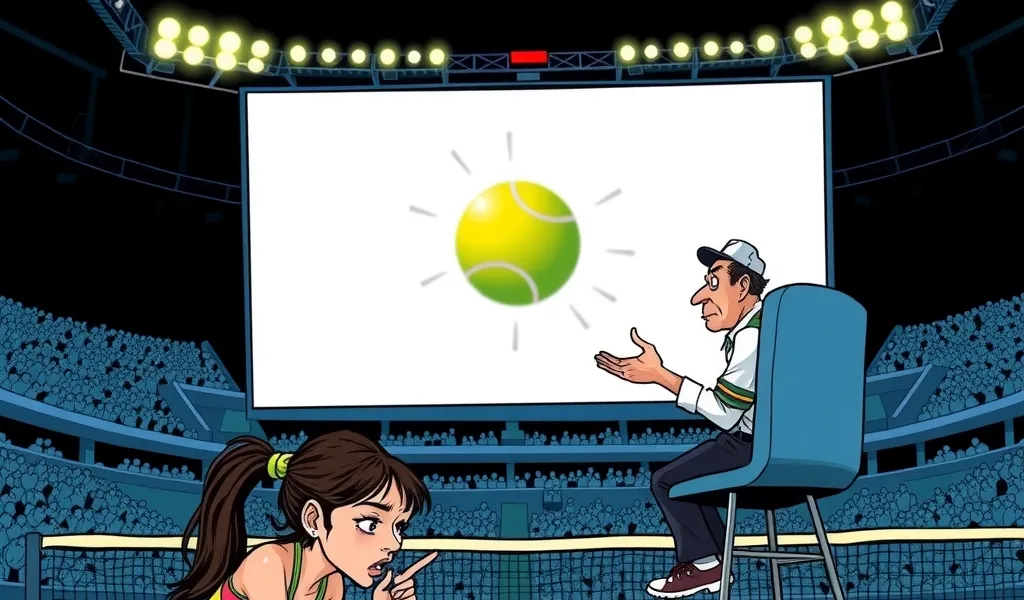
Anna Kalinskaya was playing Anna Blinkova in the first round. Second set, Kalinskaya serving at 2-2, up 40-15. She hit a crosscourt forehand that landed inside the sideline — not on it, not near it, inside it, as the broadcast cameras would shortly confirm to anyone with a television.
The electronic system called it out.
This happens; the tolerance on these systems is a few millimeters and every so often a shot near the line gets the wrong call and the world moves on. But this shot was not near the line, and Kalinskaya, who was standing closer to it than any camera, knew that immediately. She gestured at the mark. She asked for the replay, which in 2026 is the mechanism that exists precisely for this: put the shot on the big screen, everyone looks, the call gets corrected, play resumes.
The big screen lit up. It showed a serve. A different serve, from a different point, landing well outside a completely different line.
The Conversation
At this stage, a player has two options. Kalinskaya took both. First she said the thing every tennis player has wanted to say to a chair umpire since the invention of the chair:
“You are here to watch!”
Which is, on inspection, an unanswerable point. The chair umpire is the one human official left on a court with electronic line calling. Their entire remaining function, having ceded the lines to the cameras, is to sit up high and see things. When the cameras are wrong and the replay is broken, the umpire is not a redundancy. The umpire is the whole system.
Then Kalinskaya asked for the supervisor. The umpire declined, on the grounds that the ball was too close to overrule — which is a curious position to take about a ball you have just watched a replay of, given that the replay was of a different ball.
Kalinskaya lost the point. She then won the match, 6-4, 6-3, which is the only reason this is a story about a point and not a story about a result.
The Admission
Here is the unusual part. The USTA, which is not an organization known for volunteering its errors, put out a statement afterward acknowledging two of them.
One: the system malfunctioned. The call was wrong. The ball was in.
Two — and this is the one that matters — the officials on court did not follow protocol. When the replay failed, the correct procedure was to go to video review, the same mechanism the tournament uses for double bounces and touches. It exists. It was available. In the USTA’s own words, “in this case, video review should have been applicable.” Nobody used it. The umpire looked at footage of the wrong point, decided the right point was too close to call, and moved on.
Read that sequence again with the machine’s promise in mind. The cameras failed. The backup to the cameras failed. The human whose job was to catch both failures ruled that she could not, because the thing she was looking at — which was the wrong thing — was inconclusive. At no stage was the system’s answer I don’t know, let’s find out. At every stage the answer was the system has spoken.
The Red Lights
The US Open’s response, beyond the statement, has been to install red lights on top of the net posts — the Australian Open model — so that when the system calls a ball out, a light comes on. This is meant as a visual confirmation for players and fans, a way of making the machine’s verdicts feel less like a disembodied voice from the ceiling.
It is a fine idea. It does not, however, address what happened to Kalinskaya, because the light would have come on. The light is wired to the system. When the system is wrong, the light is wrong with it, brightly and in red.
The Point, Again
Fans online spent a day or two calling for the umpire to be barred, which is unfair; the umpire followed the system, and the system is what the tournament built. But Kalinskaya’s four words are going to outlast the outrage, because they describe the actual job. The lines are the cameras’ problem now. Everything else — the replay that shows the wrong point, the protocol nobody triggers, the player pointing at a mark that everyone in the building can see — is still, and only, a person’s.
You are here to watch.
Sources:
- After Anna Kalinskaya Robbed by ‘Crazy’ US Open Call Despite Her Protests, USTA Addresses ELC Malfunction — Yahoo Sports
- US Open 2026: USTA Admits Anna Kalinskaya Electronic Line-Call Error — Just Women’s Sports
- US Open Admits Protocol Error After Electronic Line-Call Blunder During Anna Kalinskaya’s Match — Yahoo Sports
- “Umpire should be barred” — Fans shocked after ‘ridiculous’ Hawkeye error at US Open in Anna Kalinskaya’s 1R win — Sportskeeda
- US Open Introduces Crucial Change as Electronic Line-Calling Faces Scrutiny — EssentiallySports