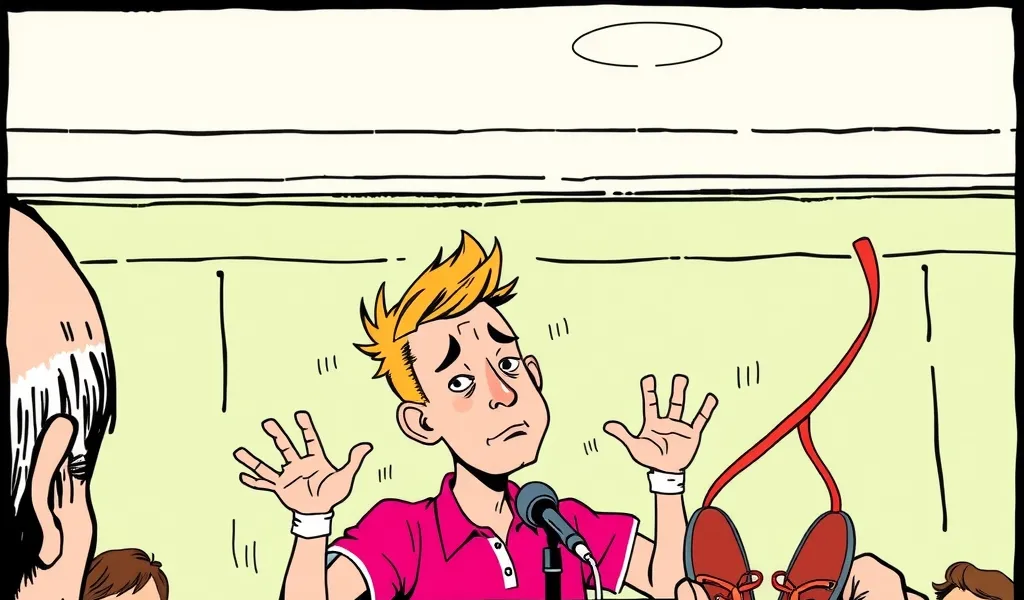
There is a particular kind of press-conference question that only exists in professional tennis. It is not a question about the match. It is not a question about the opponent. It is a question about the discourse — about what people online have been saying about you — dressed up as a question about your feelings regarding the discourse. It is, in structure, a snake eating its own tail, and on Wednesday afternoon at Flushing Meadows it was fed to a 19-year-old who had just lost 6-2, 6-1, 6-1 and was in no mood to be a snake.
Rafael Jódar is the world No. 13. He is Spanish. He won his first ATP title this spring at the Grand Prix Hassan II in Marrakech and made the quarterfinals of Roland Garros a few weeks later, which is the kind of season that gets you called the future of Spanish tennis by people who said the same thing about somebody else two years ago. He arrived at the US Open as a real contender. He left it in the first round, in about ninety minutes, having won four games against Yunchaokete Bu.
That is a bad day. It is a genuinely bad, career-marking, drive-home-in-silence day. And the first thing anyone wanted to talk about was his footwear.
Shoelace-Gate, Recapped For The Uninitiated
To understand the press conference you have to understand August.
During the North American hardcourt swing, Jódar’s shoelaces kept snapping. Not once. Repeatedly, across multiple matches, forcing him to stop play, sit down, and re-lace. This is an objectively strange thing to happen to a professional athlete whose equipment is provided and inspected by a multinational corporation, and it would have remained a quirky footnote if not for Cincinnati.
In Cincinnati, Jódar played Denis Shapovalov. Shapovalov led 5-1 in the deciding set. He had match points. And then, at 5-3, Jódar’s shoelace broke — for the second time in the match — and play stopped for roughly four minutes while he dealt with it. Jódar came back from the changeover, saved the match points, won the set, and won the match.
Shapovalov was, to put it delicately, not impressed. He suggested afterward that the stoppages had given his opponent time to catch his breath and had broken his own rhythm. The internet, which does not put things delicately, went further: cheat, insufferable, dark arts. One of Emma Raducanu’s former coaches publicly defended Jódar. The phrase “shoelace-gate” was coined, deployed, and became the only thing anyone wanted to ask him about for the rest of the summer.
None of which has anything to do with losing 6-2, 6-1, 6-1 to Yunchaokete Bu on a Wednesday in Queens. Jódar’s shoelaces held. His game did not.
The Question
Here is the question, as asked, as best it can be reconstructed from the transcript:
“When your shoelaces were breaking, I’m sure you noticed a lot of people were talking about it online. Are you worried that if you talk about your physical condition, people might think you’re making excuses, basically?”
Read it twice. It is a question about whether he is worried about being perceived as making excuses for something that did not happen, in a match he had just lost for reasons entirely unrelated to it, based on things strangers said about him three weeks ago. The word basically at the end is doing the heavy lifting of a person who realized, mid-sentence, that the sentence had gotten away from them.
Jódar’s response, in full:
“What’s the question? The shoelaces didn’t break today.”
The reporter tried again. Jódar again:
“I don’t know. I don’t know the question.”
And then, closing the matter:
“Doesn’t make sense.”
The Correct Reading
The temptation is to file this under teenager snaps at reporter, and several outlets did. That is the wrong reading. Watch the exchange and what you see is not a player losing his temper. It is a player, in the immediate aftermath of the worst loss of his season, being asked to have an opinion about a meta-narrative, and declining — not rudely, but literally. He genuinely could not locate the question inside the question. He said so. Three times, each shorter than the last.
The shoelaces didn’t break today is, when you sit with it, a perfect sentence. It is a factual statement. It is a complete rebuttal. It is also, unintentionally, a small tragedy: the shoelaces held and he lost anyway, which is the single detail that makes the whole August discourse collapse. Whatever Jódar’s laces did or did not do to Denis Shapovalov’s rhythm, they were not the reason he beat him, and their staying intact was not the reason he lost to Bu. He was just better in one match and much worse in the other. That is tennis. It is not a scandal. It is Wednesday.
What Happens Now
Jódar goes home. He is 19, ranked 13th in the world, with a title and a Grand Slam quarterfinal on the year. His season is, by any adult measure, a triumph. The shoelace story will follow him to the Asian swing and probably to Australia, because tennis media has the memory of an elephant and the attention span of a gnat, and shoelace-gate is much easier to type than variance.
The reporter, presumably, also goes home. Somewhere on the drive, one hopes, they replay the question in their head and hear what Jódar heard.
Doesn’t make sense.
Sources:
- ‘Doesn’t Make Sense’ – Rafael Jódar Snaps at Reporter Over ‘Excuses’ Question on Past Controversy After US Open Loss — Yahoo Sports
- Rafael Jodar snaps at US Open reporter over shoelace controversy question — Yahoo Sports
- Jódar’s altercation with a journalist who asked him about his shoelaces — Puntodebreak
- “What a cheat”; “Insufferable” — Fans brutally slam Rafael Jodar after new shoelace drama vs Denis Shapovalov at Cincinnati Open — Sportskeeda
- Denis Shapovalov was not impressed — and Rafael Jodar has now responded to bizarre Cincinnati moment — Yardbarker
- Jódar’s dismal US Open: from disaster on court to an uncomfortable press conference — Claytenis