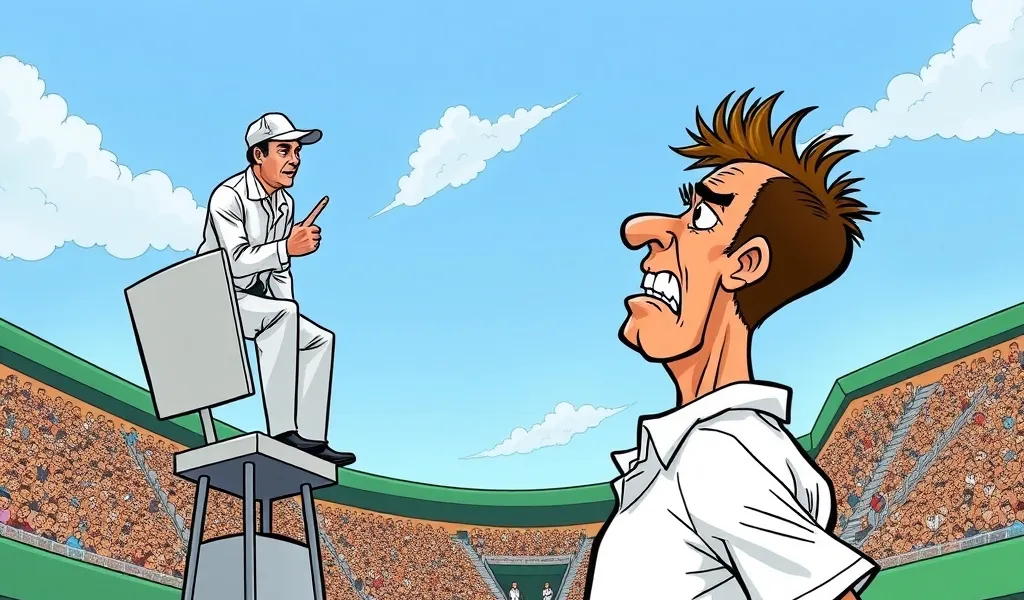
In a moment that will live forever in the annals of professional tennis — right up there alongside Nastase, McEnroe, and that one guy who hit a ball boy — 21-year-old Arthur Géa stood in the middle of Court 14 at Roland Garros on Monday and made the chair umpire an offer he could not, legally, accept.
The offer: allow Géa to leave the court for a bathroom break, or watch him solve the problem right there on the clay.
The umpire declined.
The Situation, As It Unfolded
Géa, a French wildcard making his Roland Garros debut, was trailing Karen Khachanov 4-2 in the first set when nature began staging its own first-round upset. Paris was sitting at 88 degrees — twenty degrees hotter than a typical late-May afternoon — and Géa had woken up that morning already feeling ill. He says he wasn’t sick the night before. His stomach apparently decided tournament day was the moment to weigh in.
Mid-game, Géa approached the chair umpire and made his case with the quiet dignity of a man who has perhaps thirty seconds of dignity remaining.
“I think it’s going to go out, really,” he reportedly told the official. “I cannot wait. It’s not a joke.”
The umpire, citing tournament regulations, explained that bathroom breaks are only permitted between sets. Not during sets. Rules are rules. The tour has a schedule to maintain.
Géa processed this information.
Then Géa made his counter-proposal.
“I’m gonna s*** on the f***ing court.”
The Regulations In Question
The French Tennis Federation has spoken, and it has spoken clearly: you may use the restroom between sets. During a set, you will hold it. This is the rule. The rule does not flex for heat waves, stomach bugs, wildcard debutants, or the structural dignity of the sport itself.
To be fair to the officials, this rule exists for legitimate reasons. The tour has seen its share of well-timed “bathroom breaks” that conveniently align with momentum shifts and injury timeouts that last exactly as long as the opponent’s hot streak. The regulations are there to keep the game fair.
What the regulations did not fully anticipate was a 21-year-old Frenchman prepared to go full scorched-earth as a negotiating tactic.
It Did Not Work
Géa did not, in fact, execute on his threat. The match continued. He then lost to Khachanov 6-3, 7-6, 6-0 — which, given the circumstances, probably felt like the least of his problems.
After the match concluded, tournament officials did allow Géa to use the restroom. Under what the Federation described as “medical circumstances.” Medicine was also provided for stomach pain. The Federation’s generosity, it turns out, has a trigger: the match ending.
Géa, to his credit, did not complain in his post-match comments. He explained the situation matter-of-factly: he felt fine the night before, felt worse when he woke up, grew progressively more desperate as the match wore on in the heat, and made a calculation in real time about his available options. He came to the correct conclusion that none of them were good.
The Broader Picture
This is Roland Garros in 2026: 90-degree heat, no electronic line-calling, and a ballgirl who suffered heat stroke during the Rublev match on the same afternoon. The French Tennis Federation is currently in a standoff with players over prize money distribution, engaged in a dispute about modernizing line calls, and now presiding over a situation where a player threatened to defecate on their courts rather than forfeit a point.
It is, all things considered, a lot.
Géa will almost certainly be back at Roland Garros. He is young, French, and clearly willing to go the distance — in more ways than one. When he returns, one hopes the weather will be cooler, the stomach will be settled, and the Federation will have quietly reconsidered at least one of its regulations.
In the meantime, he has achieved something every first-time Grand Slam entrant dreams of: he will be remembered.
Sources:
- Arthur Géa urgently pleads for bathroom break while feeling ill during French Open first-round match vs. Karen Khachanov — Yahoo Sports
- French tennis star threatens to “s—t on the f—king court” during explosive meltdown at Roland Garros — Total Pro Sports
- French Open player begs umpire for emergency bathroom break on court — Fox News
- French Open 2026: Drama already unfolding at Roland Garros in opening days — Yahoo Sports