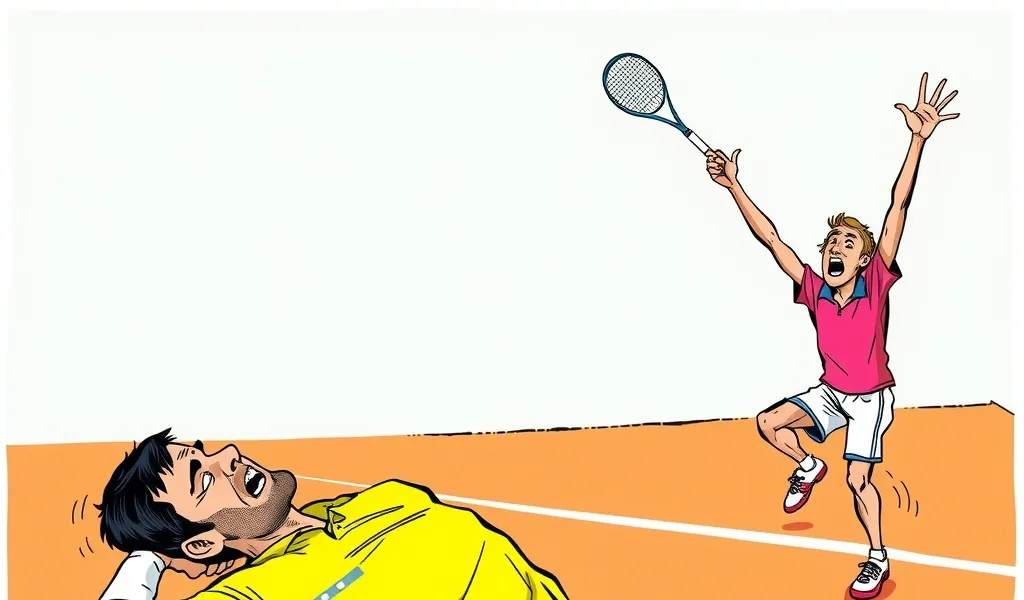
There is a certain category of Novak Djokovic loss that feels like watching a documentary about the slow erosion of a coastline. Friday’s match against João Fonseca was not that. Friday’s match was watching the coastline get up and walk into the sea.
The 39-year-old Djokovic — winner of 24 Grand Slams, owner of a previously perfect 18-0 record against teenagers at majors, lifetime member of the “I Do Not Lose Two-Set Leads” club — went up two sets to love on a 19-year-old Brazilian making his Roland Garros debut, and then proceeded to spend the next three hours forgetting how to play tennis. Final score: 4-6, 4-6, 6-3, 7-5, 7-5. Final duration: four hours, forty-nine minutes — the longest match of Djokovic’s Roland Garros career. Final indignity: a French crowd that booed him so consistently the chair umpire had to get on the loudspeaker and ask people to stop.
It was a very full afternoon.
The Match
Djokovic, in fairness, looked like Djokovic for two sets. Crisp groundstrokes, sharp returns, the kind of unhurried geometric authority that has been suffocating opponents for two decades. Fonseca looked like a 19-year-old who had walked into the wrong building. Then, somewhere around the start of the third set, the temperature on court hit 90 degrees and the match underwent what physicists call a phase transition.
Fonseca started swinging like a man with nothing to lose, because he had nothing to lose. Djokovic started moving like a man who was suddenly aware he was 39, because he was. The break came. Then another. By the fifth set Fonseca was hitting three drop-shot winners in a single game and serving three aces to close out the match. Djokovic, who has spent twenty years finding a way at Grand Slams, did not find a way.
Fonseca became the first teenager to defeat a former men’s singles champion from two sets down at Roland Garros since Michael Chang did it to Ivan Lendl in 1989. He is also the first teenager to ever beat Djokovic at a Grand Slam, full stop. The 18-0 record is now 18-1, which is the kind of statistic that gets engraved on a plaque somewhere.
The Booing
The match against Fonseca was actually Djokovic’s third-round contest. In the second round, he played a 25-year-old Frenchman named Valentin Royer, which is the sort of matchup the Roland Garros crowd treats the way a labrador treats a steak. The booing started early and did not let up. Whether the French were booing Djokovic out of patriotic loyalty to Royer or out of the more general and longstanding French distaste for Djokovic the man is, as several outlets have pointed out, genuinely unclear.
At one point it got bad enough that the chair umpire had to make a public address announcement. The exact words, broadcast over the loudspeakers of Court Philippe Chatrier: “Ladies and gentlemen, please have some respect for both of the players.”
Djokovic, from across the net, audible on broadcast: “They don’t have respect.”
This is a man who has won twenty-four Grand Slams. Three of them have been the French Open. He has stood on that court holding the Coupe des Mousquetaires more times than most players will ever set foot on it. The relationship has remained, somehow, deeply unresolved.
The Cameraman
Between the second and third set of the Fonseca match — which is to say, the exact moment when everything started going wrong — Djokovic was changing clothes at his chair and preparing for the next set. A cameraman, doing what cameramen do, positioned himself a touch closer than Djokovic considered ideal. Djokovic looked straight down the barrel of the lens and delivered the following:
“Can you come more in my face? For god sake, make some space!”
It is not, in the grand pantheon of athlete-on-cameraman quotes, an all-timer. But it does have a certain compressed energy to it — the rhetorical question, the desperate sigh of “for god sake,” the explicit instruction to make some space — that suggests the cameraman was operating well within Djokovic’s personal bubble at a moment when the personal bubble was already under significant external pressure.
The TNT commentary team, which included former Andy Murray coach Miles MacLagan, actually sided with Djokovic. The cameraman, they noted, was a little close. The day was very hot. Some breathing room was warranted. This is the kind of defense that gets mounted when a player has just yelled at someone holding a camera and the broadcast booth wants very much to move on.
What Happens Now
Djokovic was, before this loss, the obvious co-favorite to win his 25th major. He is now out of Roland Garros, having dropped a five-setter to a teenager he had two sets in hand against. In his post-match press conference, asked about his future, he kept things — to use the word every outlet has used — vague.
The vagueness is the part to watch. Djokovic at 39 is still capable of winning Grand Slams. Djokovic at 39 is also, demonstrably, capable of losing two-set leads to teenagers in 90-degree heat while a French crowd boos and a cameraman gets a little too close. Both things are now on the record. Both things, presumably, were on his mind in the locker room afterward.
Fonseca, for his part, called Djokovic his idol. Then he went and beat him. This is sort of how it is supposed to go, eventually, in any sport. It is also approximately never how it goes for Novak Djokovic. Until it does.
Sources:
- Novak Djokovic falls to shock Roland Garros loss against Brazilian teen — CNN
- 2026 French Open results: Joao Fonseca stuns Novak Djokovic in five-set instant classic at Roland-Garros — CBS Sports
- Novak Djokovic Ruthlessly Booed at Roland-Garros — ‘No Respect’ — Yahoo Sports
- Novak Djokovic issues strong complaint during Roland Garros match against Joao Fonseca — Tennis365
- Novak Djokovic Keeps Future Tennis Plans Vague After Roland-Garros Exit — Newsweek