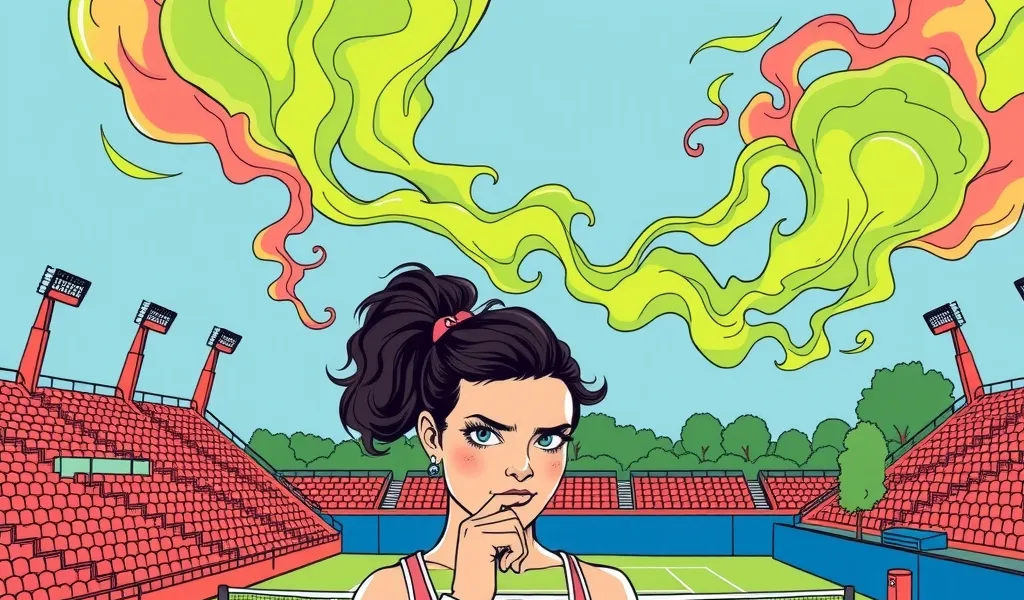
At the USTA Billie Jean King National Tennis Center in Flushing Meadows, on any given afternoon in early September 2026, a professional tennis player is trying to hit a topspin backhand crosscourt. This is a task requiring immense concentration. The margin between hitting the ball in and hitting the ball out is measured in the same units used to describe the width of a credit card. The player has spent, at minimum, fifteen years of their life learning to do it.
Approximately eighty yards away, in Corona Park — which is a public New York City park, adjacent to the tennis center, in a state where cannabis has been legal for adults over 21 since 2021 — a person is sitting on a bench, using a personal amount of cannabis, in the way that people in New York have been doing in public parks for approximately five years now without any particular incident.
The wind, on some afternoons, blows one way. The wind, on other afternoons, blows the other way. And on the afternoons when the wind blows one way, the smell of said cannabis reaches the practice courts, the outer show courts, and — on at least one occasion this year — Louis Armstrong Stadium, in the middle of a third-round match featuring Aryna Sabalenka, the world No. 1.
Sabalenka, standing on Louis Armstrong Stadium during her third-round match against Kamilla Rakhimova on September 4, addressed the situation directly, over the on-court microphone, to whoever the responsible party happened to be:
“Guys, you can do whatever, you can smoke whatever, you can relax as much as you can, but please, to not do it around the tennis courts.”
It is one of the most Aryna Sabalenka sentences ever recorded. Every clause opens with permission and closes with a boundary. The world No. 1 is not, on principle, opposed to your leisure activities. She simply requires a spatial buffer. Later, in her press conference, she added: “I don’t know if it was, like, coming from the crowd or was from the outside because the wind blows it into the stadium.” And, with the deadpan of a woman who has clearly thought about this for longer than she wants to: “Maybe it’s too fast so they want to slow down a little bit, so who knows. I don’t know the effect from it.”
She was not wrong. Someone was, indeed, smoking. The tennis authorities have confirmed this. The tennis authorities cannot, they have also confirmed, do anything about it.
The Boulter Interview
Katie Boulter, the British No. 1 and a top-40 player on tour, addressed the issue in a pre-tournament press conference this week. Asked whether she had noticed the smell during her preparation, she said the following:
“Yeah, I have experienced it. You go down to the practice courts and down in the park courts, you do smell it a lot. But yeah, I’m not a huge fan of it.”
She then added:
“I’ve played on one before and I did smell it during my match. It’s something that I wouldn’t like to smell in the middle of my match. I’m trying to focus and then obviously, it takes you out of the moment and you really don’t want to. You don’t need distractions.”
This is, to be clear, an extremely reasonable series of statements. A professional tennis player, at a Grand Slam, has been asked about a specific environmental factor she has encountered during play. Her answer is: the smell is present, I am aware of it, I would prefer it not be there, and it makes concentration harder.
This should be uncontroversial. This is a top-ten sports figure describing her workplace conditions. And yet, because tennis in 2026 exists inside the larger cultural moment of “everything is a fight about something,” what she said has now been characterized in various outlets as ranging from reasonable complaint to British condescension to culture-war grievance to, on one particularly aggressive site, anti-New-York bigotry.
The relevant word here, for both sides of that argument, is: she plays tennis. She is not a policy advisor. She has, professionally, one job. That job is to hit a ball into a rectangle. When something in the ambient environment makes hitting the ball into the rectangle harder, she is entitled to say so. That is not a political statement. That is a description of the room.
The USTA Statement, Which Does Not Really Say Anything
The USTA, asked about the ongoing cannabis-smell issue at the tournament, has issued a statement that includes the phrase we remain vigilant and does not include any specific plans to address the situation. This is a statement written by a person who understands that (a) they cannot control what happens in Corona Park, (b) the New York State legislature cannot easily be lobbied to change the cannabis laws in three weeks, and (c) most importantly, the players will keep playing regardless. The players are contracted. The prize money is real. The tournament will not be canceled because someone on a park bench decided to relax.
The USTA has, for what it is worth, been dealing with this specific problem since at least 2022, when Nick Kyrgios first mentioned that a fan smoking near his court had triggered his asthma. Maria Sakkari raised the issue mid-match in 2023. Sabalenka raised it this week. It is now, five tournaments in a row, a recurring news story in early September. The word institutional is doing a lot of work in the tennis-industrial complex right now, and institutional is the correct word for a problem that has been ongoing since 2022 with the same statement being issued about it each time.
The Vibe
The vibe, however, is that this is now simply part of what tennis is at the US Open. Court 17 — the outer court nearest the park, infamous for this since it opened in 2011 — has always smelled like weed. The practice courts have always smelled like weed. It is, at this point, more consistent than the food service. When a first-time attendee at the US Open asks a veteran what they should know, one of the top three answers is: you might smell some weed. Nobody promises it will not happen. Nobody organizes to make it stop. It is simply, in the way certain New York experiences are, part of the deal.
Aryna Sabalenka won that match despite the ambient distraction and remains a favorite for the title. Katie Boulter lost her second-round match to Karolína Muchová 6-1, 6-0 in fifty-eight minutes — on Louis Armstrong, as it happens — in what the British press described as the worst Grand Slam defeat of her career and, in one memorable headline, a mauling, which is a fun word for a tennis result. Whether the ambient marijuana was a factor is impossible to say. The New York wind, on that day, was blowing east.
Sources:
- British hopefuls at US Open say marijuana smell is ‘distracting’ — ESPN
- Aryna Sabalenka complains about the smell of marijuana during her US Open match — ABC News
- ‘Someone is smoking weed’: Sabalenka halts US Open match due to cannabis smell — inkl
- Katie Boulter joins growing list of players bothered by cannabis smell — Tennis Up To Date
- Tennis players raise concerns over cannabis smell at US Open 2026 — WION