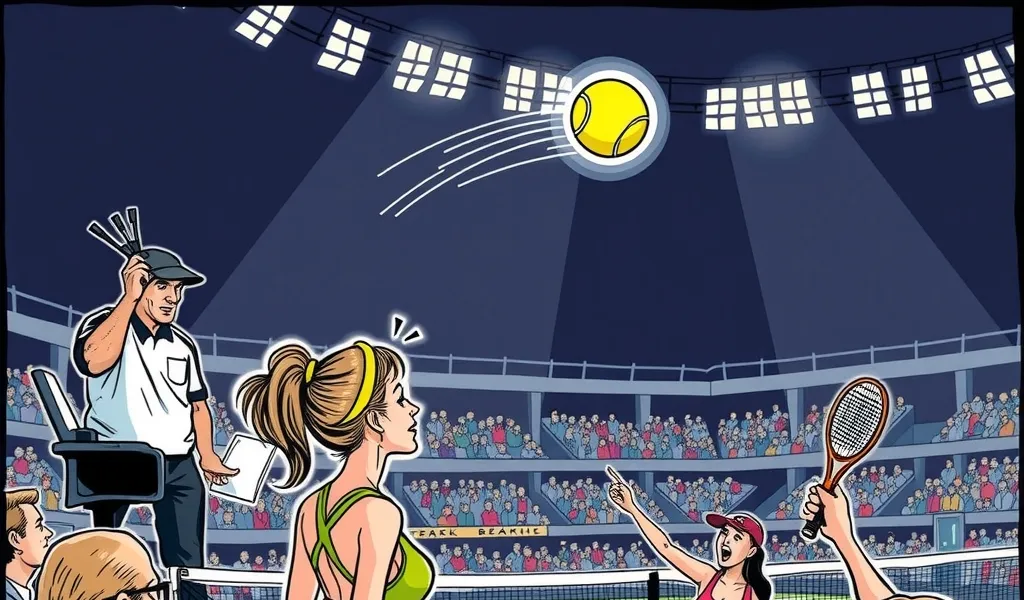
On September 6, 2020, Novak Djokovic — then the world No. 1, then unbeaten on the year, then a heavy favorite to win the US Open — dropped serve in the first set of his fourth-round match, pulled a ball out of his pocket, and swatted it behind him without looking. It hit a line judge in the throat. She went down. He was defaulted from the tournament on the spot, and the USTA released a statement citing the rulebook’s language about hitting a ball “with negligent disregard of the consequences.”
That day has been the reference point for every tennis fan’s understanding of the rule ever since: you hit someone with a ball you weren’t looking at, you go home. It is, as tennis rules go, unusually clean.
On September 2, 2026, on the same court, in the first round of the same tournament, Belinda Bencic dropped serve early in the second set, pulled a ball out, and swatted it behind her without looking. It went into the stands and hit a spectator.
She received a code violation. She kept playing.
The Exchange
Bencic, the 12th seed, had won the first set 6-4 against Yulia Putintseva and led 2-0 in the second before losing serve. The ball she hit in frustration cleared the court and struck a fan. The fan, by every account, was fine — startled, not hurt.
Putintseva was not fine. She went to the chair.
“She hit the ball outside. She hit someone.”
The chair umpire agreed that Bencic had hit the ball outside and that it had hit someone, and explained, in the calm voice umpires use when they know the transcript is going to be quoted, the distinction being applied. Was it intentional? No. Did it eventually hit someone? Yes. The person is fine. So she received the code violation for that.
Putintseva, who had clearly been watching tennis in 2020, delivered the line of the match:
“But the person that Djokovic hit was also fine.”
Which is — you have to give it to her — an exceptionally well-aimed sentence. Because the line judge in 2020 was, in the end, fine. She was treated, she recovered, she was back at work. The default was not issued because of the severity of the injury. It was issued because of the act.
Putintseva then went back and won the match, 4-6, 7-5, 6-3, which is either the universe restoring balance or just what happens when you rattle a seed early in the second set. Both can be true.
The Actual Rule
The Grand Slam rulebook does not say “hit a spectator and you are out.” It says players may not hit a ball dangerously or recklessly, and it hands the referee a great deal of discretion about what “dangerously” and “recklessly” mean and whether the outcome warrants a warning, a point, a game, or the door.
In 2020, the referee decided that a ball struck without looking, which hit a person in the throat hard enough to drop her, met the standard. In 2026, the referee decided that a ball struck without looking, which hit a person in the stands who then sat back down, did not. The physical act — turn, swat, don’t look — is identical in both cases. The difference is where the ball landed and who it landed on, which is to say: the difference is luck.
That is what fans are now arguing about, and it is a real argument. One camp says the rule is working exactly as designed: discretion exists so that a startled fan and a hospitalized official are treated differently. The other camp says a rule whose outcome depends entirely on the ball’s flight path is not a rule about conduct at all; it is a rule about aim, and it rewards players whose reckless swipes happen to miss. Several are calling for an automatic default for any angry ball that strikes a person, no discretion, no “is the person fine,” so that nobody ever has to have the Putintseva conversation again.
The Uncomfortable Part
It is worth saying plainly what the Djokovic comparison implies and what it does not. It does not imply that Bencic should have been thrown out of the US Open for a moment of frustration that hurt nobody. Most people watching, including most people who think the rule is inconsistent, did not want that.
What it implies is the other direction: that if this is the standard, then the most consequential officiating decision in modern tennis — the one that ended the year of an undefeated world No. 1 in the fourth round of a Slam — was made on the basis of where a ball happened to land, and a differently-aimed swat would have produced a warning and a shrug. Djokovic forfeited every dollar of prize money and every ranking point he had earned that fortnight, and was fined on top of it. Bencic received a sentence on a scoresheet.
Both players hit a ball without looking. One of them got unlucky.
The person is fine is a perfectly reasonable thing for a chair umpire to say. It is also, as Putintseva pointed out, a thing that was true the last time too.
Sources:
- Did she deserve the disqualification? Belinda Bencic escapes default after hitting spectator as Putintseva invokes Djokovic — Yardbarker
- Belinda Bencic Avoids Novak Djokovic-Style Punishment After Hitting Spectator at US Open — EssentiallySports
- Belinda Bencic Escaping Default for ‘Reckless’ Act Stuns Tennis World As Novak Djokovic Gets Pulled Into US Open Row — Yahoo Sports
- Tennis fans call for rule change after top seed caught in disqualification drama at US Open — Yahoo News Australia
- Belinda Bencic avoids Djokovic-style US Open default after hitting spectator with ball — Yardbarker